Yappy
Yappy
Designing a Conversation Game That Adapts
Designing a Conversation Game That Adapts
Designing a Conversation Game That Adapts
The Problem
The Problem
We've all been there. You're at a party making painful small talk. You're on a first date and the conversation hits a wall. You're three hours into a road trip and everyone's run out of things to say.
Awkward silences are universal. But the solutions aren't great.
Most conversation games fall into two camps: either too safe (boring icebreakers that feel like corporate team-building) or too chaotic (friendship-ending questions that only work if everyone's drunk). Nothing adapts to the actual context you're in.
A networking event with strangers needs fundamentally different questions than a road trip with your best friends. Yet every conversation game treats these situations the same.
I saw an opportunity to design something smarter.
Designing the Adaptive System
Yappy's core interaction starts with a simple setup flow. Three questions, three taps, and the game knows exactly what you need.
"How much time do you have?"
"How many people?"
"How well do you know each other?"
These three inputs create a filtering system. Behind the scenes, every question in the database is tagged with mode, minimum group size, and spice level. The system matches questions to context automatically.
One product. Infinite situations.
This is the kind of systems thinking that scales - the same architecture could support hundreds of questions across dozens of contexts without changing the core experience.
We've all been there. You're at a party making painful small talk. You're on a first date and the conversation hits a wall. You're three hours into a road trip and everyone's run out of things to say.
Awkward silences are universal. But the solutions aren't great.
Most conversation games fall into two camps: either too safe (boring icebreakers that feel like corporate team-building) or too chaotic (friendship-ending questions that only work if everyone's drunk). Nothing adapts to the actual context you're in.
A networking event with strangers needs fundamentally different questions than a road trip with your best friends. Yet every conversation game treats these situations the same.
I saw an opportunity to design something smarter.
Designing the Adaptive System
Yappy's core interaction starts with a simple setup flow. Three questions, three taps, and the game knows exactly what you need.
"How much time do you have?"
"How many people?"
"How well do you know each other?"
These three inputs create a filtering system. Behind the scenes, every question in the database is tagged with mode, minimum group size, and spice level. The system matches questions to context automatically.
One product. Infinite situations.
This is the kind of systems thinking that scales - the same architecture could support hundreds of questions across dozens of contexts without changing the core experience.
Role
Role
Role
Product Designer
Product Designer
Year
Year
Year
2025
2025
Platform
Platform
Platform
Mobile (iOS/Android)
Mobile (iOS/Android)
Mobile (iOS/Android)
Service Provided
Service Provided
Service Provided
Product Design
Product Design
Product Design

The Insight
The Insight
The best conversations don't come from nowhere. They come from a single great question asked at the right moment.
The key word is "right." A question that sparks a two-hour debate between close friends might create uncomfortable silence between acquaintances. Context matters - but no existing product accounts for it.
I set out to design a conversation game that adapts to three variables:
Time available - Are you in an elevator or on a cross-country drive?
Group size - Is this intimate or a party?
Relationship depth - Did you just meet or have you known each other for years?
Get these three inputs, and you can serve the perfect question for any situation.
Working Within Constraints
Yappy was built in 6 days for a hackathon. Constraints forced clarity.
What I cut:
Dark mode
→ Core flow mattered more than themesUser-generated questions
→ Moderation complexity wasn't worth it at MVPAccount system
→ No login needed, reduces friction to zeroDesktop version
→ Mobile-first because 95% of use cases are in-person
Trade-offs I made:
Predefined questions over dynamic AI generation
→ Consistency and quality controlLocal storage over cloud sync
→ Privacy-first, no server costsSpice levels over age-gating
→ Users self-select appropriateness
What broke and how I fixed it:
"Just met" spice level had only 1 question
→ Wrote 10 more level-1 questionsSettings menu buttons weren't functional
→ Debugged state management3D mascot wouldn't load
→ Switched from broken CDN to Imgur hosting 🤪
Every constraint was a forcing function for better decisions.
The best conversations don't come from nowhere. They come from a single great question asked at the right moment.
The key word is "right." A question that sparks a two-hour debate between close friends might create uncomfortable silence between acquaintances. Context matters - but no existing product accounts for it.
I set out to design a conversation game that adapts to three variables:
Time available - Are you in an elevator or on a cross-country drive?
Group size - Is this intimate or a party?
Relationship depth - Did you just meet or have you known each other for years?
Get these three inputs, and you can serve the perfect question for any situation.
Working Within Constraints
Yappy was built in 6 days for a hackathon. Constraints forced clarity.
What I cut:
Dark mode
→ Core flow mattered more than themesUser-generated questions
→ Moderation complexity wasn't worth it at MVPAccount system
→ No login needed, reduces friction to zeroDesktop version
→ Mobile-first because 95% of use cases are in-person
Trade-offs I made:
Predefined questions over dynamic AI generation
→ Consistency and quality controlLocal storage over cloud sync
→ Privacy-first, no server costsSpice levels over age-gating
→ Users self-select appropriateness
What broke and how I fixed it:
"Just met" spice level had only 1 question
→ Wrote 10 more level-1 questionsSettings menu buttons weren't functional
→ Debugged state management3D mascot wouldn't load
→ Switched from broken CDN to Imgur hosting 🤪
Every constraint was a forcing function for better decisions.
Results
Results
Here's something I noticed about conversation games: people cheat.
Not maliciously. But when you ask someone "Would you rather have your texts published or your photos displayed publicly?" most people give a safe, diplomatic answer. "Probably the texts, I guess." Conversation over.
The question was good. The answer was boring. Why?
Because there was an easy escape route. No accountability. No follow-through.
I designed a two-tier question system to close this loophole.
How it works:
Every substantial question has two parts:
Primary Question: The impossible choice
Follow-Up: The accountability layer that prevents cop-outs
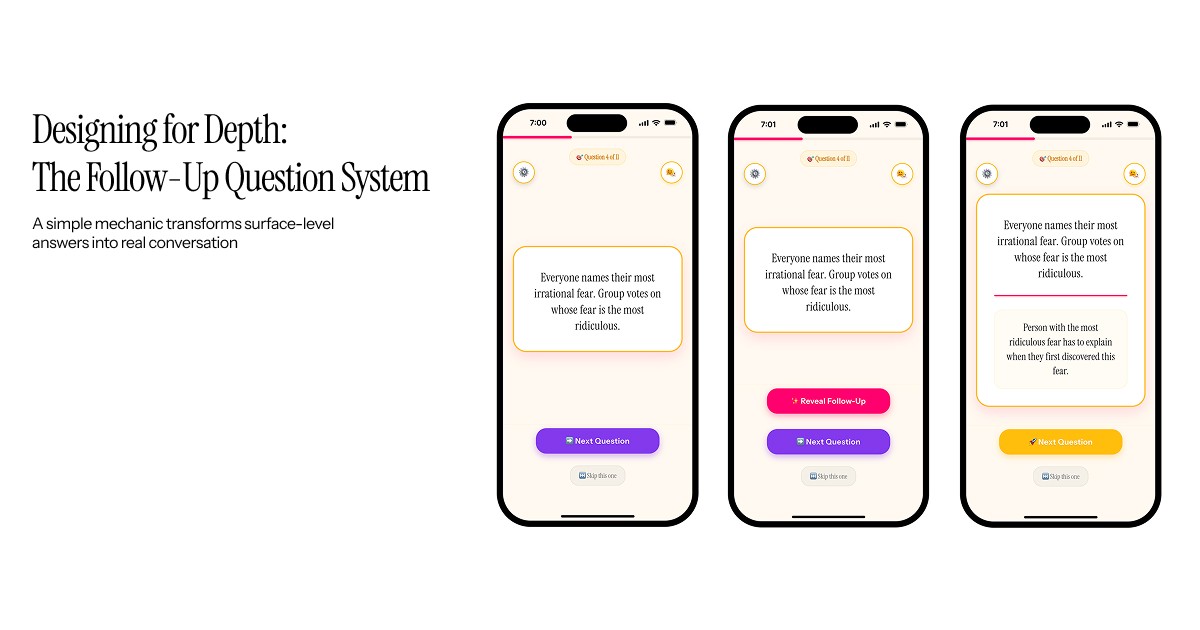
The follow-up doesn't appear immediately. There's a 3-second delay before the "Reveal Follow-Up" button slides into view. This creates anticipation and gives people time to commit to their initial answer.
When they tap reveal, the button animates away, a subtle divider appears, and the follow-up fades in below.
Example in action:
Primary: "You can erase one memory from your mind forever, OR force one person to forget something specific about you."
Follow-up: "If you picked erasing your memory - what is it? If you picked the other person - who and what?"
Now there's nowhere to hide. "I'd erase a memory" becomes "I'd erase that conversation with my dad when I was 16 where I said something I can never take back."
THAT'S a conversation.
The micro-interactions matter:
3-second delay
→ Builds anticipation, prevents rushingSlide-up animation
→ Creates conversational rhythmVisual divider
→ Clear hierarchy between question tiersButton state change
→ "Next Question" shifts from outlined to solid yellow after reveal, signaling completion
These small details create a cadence that mirrors natural conversation. Pause. Reveal. Dig deeper. Move on.
The follow-up system transforms Yappy from "a list of questions" into "a mechanic that changes how people answer." That's the difference between a feature that exists and a feature that works.
Designing for Delight: Brand & Visual Identity
Yappy needed to feel warm. Approachable. The opposite of intimidating.
Most "edgy" conversation games lean into dark aesthetics - black backgrounds, harsh typography, trying to feel dangerous. But that creates anxiety before you even start playing. It signals "this might get uncomfortable" rather than "this will be fun."
I went the opposite direction.
Color Palette: Five vibrant, warm colors that feel like a party:
(Warm Yellow) - Primary, optimistic
(Vibrant Orange) - Energy, excitement
(Hot Pink) - Playful, bold
(Purple) - Creative, unexpected
(Bright Blue) - Friendly, trustworthy
Typography:
Instrument Sans for headings - Friendly but confident
Inter for body text - Clean, highly readable
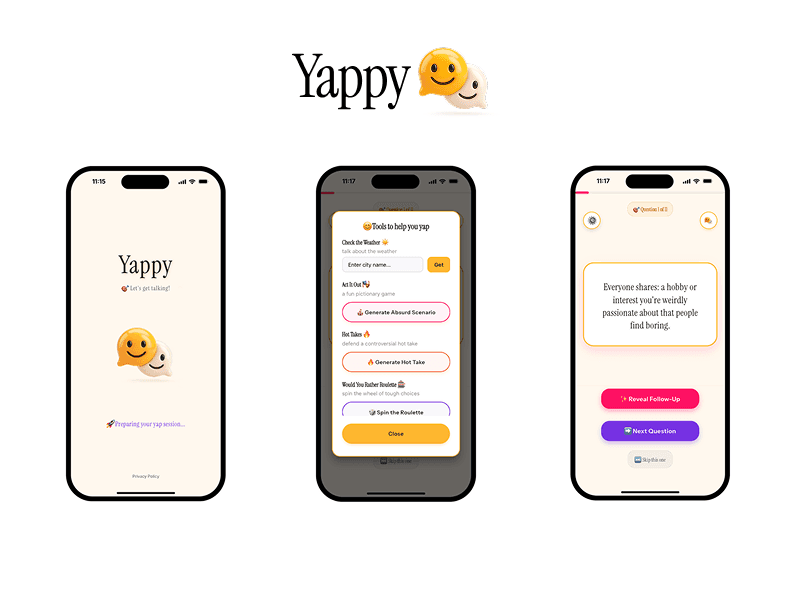
The Yappy Mascot: I created a 3D speech bubble character using Sora AI. Two overlapping bubbles with simple smiling faces - representing conversation between people.
The mascot appears throughout the app: large and bouncing on the splash screen, small and subtle in the corner during gameplay, celebratory on the completion screen. It adds personality without being annoying.
Visual Principles:
Cream backgrounds instead of harsh white
Rounded corners everywhere (minimum 16px radius)
Generous padding and breathing room
Soft shadows that create depth without heaviness
The result feels like an app you'd actually want to pull out at a party. Inviting, not intimidating.
Extending the Core: Tools to Help You Yap
Once the question system was solid, I explored how to extend the experience without complicating it.
I added a "Tools" menu - small bonus features that provide variety and keep sessions fresh:
Hot Takes Generates controversial opinions users must defend for 2 minutes, even if they disagree. "Pineapple belongs on pizza." Forces people to argue positions they don't hold - which is surprisingly fun and reveals how people think.
Would You Rather Roulette A spinning wheel mechanic that lands on random would-you-rather questions. The animation creates anticipation and makes selection feel like a game show moment.
Act It Out AI-generated absurd scenarios (via DALL-E 3) that one person must act out while others guess. "Fish lifting weights at the gym." Pure chaos energy.
Weather Report Surprisingly useful. Shows current weather as a genuine conversation starter. "It's 45 degrees and cloudy - perfect weather to stay in and keep yapping."
These tools follow a principle: extensibility without complexity. New tools can be added anytime without changing the core question experience. The architecture supports growth.
Reflection: What I Learned
On product thinking: The best features change behavior, not just interface. The follow-up question system doesn't just display more text - it fundamentally changes how people answer. That's the bar I want to hit with every feature I design.
On building end-to-end: This was my first time taking a product from zero to functional app in under a week. Using AI tools (Anything for development, Sora for the mascot, Claude for question writing) let me move faster than I ever could alone. The future of product design includes knowing how to leverage these tools effectively.
On scope: Cutting features was harder than adding them. Every "nice to have" I removed made the core experience stronger. Constraints aren't limitations - they're clarity.
On positioning: Yappy works because it solves a real problem that everyone experiences. The fanciest interaction design means nothing if the core value prop doesn't resonate. Start with the problem, not the solution.
What's Next
If I continued developing Yappy, here's where I'd go:
Analytics on question engagement
→ Which questions get skipped vs. spark long discussions?User-submitted question packs
→ Community-driven content with moderationMultiplayer sync
→ Everyone sees the same question on their own phoneShare results
→ Social-ready cards showing session statsPremium question packs
→ Themed expansions (dating, family reunions, work retreats) as monetization path
The architecture supports all of this. The foundation is built to scale.
Here's something I noticed about conversation games: people cheat.
Not maliciously. But when you ask someone "Would you rather have your texts published or your photos displayed publicly?" most people give a safe, diplomatic answer. "Probably the texts, I guess." Conversation over.
The question was good. The answer was boring. Why?
Because there was an easy escape route. No accountability. No follow-through.
I designed a two-tier question system to close this loophole.
How it works:
Every substantial question has two parts:
Primary Question: The impossible choice
Follow-Up: The accountability layer that prevents cop-outs
The follow-up doesn't appear immediately. There's a 3-second delay before the "Reveal Follow-Up" button slides into view. This creates anticipation and gives people time to commit to their initial answer.
When they tap reveal, the button animates away, a subtle divider appears, and the follow-up fades in below.
Example in action:
Primary: "You can erase one memory from your mind forever, OR force one person to forget something specific about you."
Follow-up: "If you picked erasing your memory - what is it? If you picked the other person - who and what?"
Now there's nowhere to hide. "I'd erase a memory" becomes "I'd erase that conversation with my dad when I was 16 where I said something I can never take back."
THAT'S a conversation.
The micro-interactions matter:
3-second delay
→ Builds anticipation, prevents rushingSlide-up animation
→ Creates conversational rhythmVisual divider
→ Clear hierarchy between question tiersButton state change
→ "Next Question" shifts from outlined to solid yellow after reveal, signaling completion
These small details create a cadence that mirrors natural conversation. Pause. Reveal. Dig deeper. Move on.
The follow-up system transforms Yappy from "a list of questions" into "a mechanic that changes how people answer." That's the difference between a feature that exists and a feature that works.
Designing for Delight: Brand & Visual Identity
Yappy needed to feel warm. Approachable. The opposite of intimidating.
Most "edgy" conversation games lean into dark aesthetics - black backgrounds, harsh typography, trying to feel dangerous. But that creates anxiety before you even start playing. It signals "this might get uncomfortable" rather than "this will be fun."
I went the opposite direction.
Color Palette: Five vibrant, warm colors that feel like a party:
(Warm Yellow) - Primary, optimistic
(Vibrant Orange) - Energy, excitement
(Hot Pink) - Playful, bold
(Purple) - Creative, unexpected
(Bright Blue) - Friendly, trustworthy
Typography:
Instrument Sans for headings - Friendly but confident
Inter for body text - Clean, highly readable
The Yappy Mascot: I created a 3D speech bubble character using Sora AI. Two overlapping bubbles with simple smiling faces - representing conversation between people.
The mascot appears throughout the app: large and bouncing on the splash screen, small and subtle in the corner during gameplay, celebratory on the completion screen. It adds personality without being annoying.
Visual Principles:
Cream backgrounds instead of harsh white
Rounded corners everywhere (minimum 16px radius)
Generous padding and breathing room
Soft shadows that create depth without heaviness
The result feels like an app you'd actually want to pull out at a party. Inviting, not intimidating.
Extending the Core: Tools to Help You Yap
Once the question system was solid, I explored how to extend the experience without complicating it.
I added a "Tools" menu - small bonus features that provide variety and keep sessions fresh:
Hot Takes Generates controversial opinions users must defend for 2 minutes, even if they disagree. "Pineapple belongs on pizza." Forces people to argue positions they don't hold - which is surprisingly fun and reveals how people think.
Would You Rather Roulette A spinning wheel mechanic that lands on random would-you-rather questions. The animation creates anticipation and makes selection feel like a game show moment.
Act It Out AI-generated absurd scenarios (via DALL-E 3) that one person must act out while others guess. "Fish lifting weights at the gym." Pure chaos energy.
Weather Report Surprisingly useful. Shows current weather as a genuine conversation starter. "It's 45 degrees and cloudy - perfect weather to stay in and keep yapping."
These tools follow a principle: extensibility without complexity. New tools can be added anytime without changing the core question experience. The architecture supports growth.
Reflection: What I Learned
On product thinking: The best features change behavior, not just interface. The follow-up question system doesn't just display more text - it fundamentally changes how people answer. That's the bar I want to hit with every feature I design.
On building end-to-end: This was my first time taking a product from zero to functional app in under a week. Using AI tools (Anything for development, Sora for the mascot, Claude for question writing) let me move faster than I ever could alone. The future of product design includes knowing how to leverage these tools effectively.
On scope: Cutting features was harder than adding them. Every "nice to have" I removed made the core experience stronger. Constraints aren't limitations - they're clarity.
On positioning: Yappy works because it solves a real problem that everyone experiences. The fanciest interaction design means nothing if the core value prop doesn't resonate. Start with the problem, not the solution.
What's Next
If I continued developing Yappy, here's where I'd go:
Analytics on question engagement
→ Which questions get skipped vs. spark long discussions?User-submitted question packs
→ Community-driven content with moderationMultiplayer sync
→ Everyone sees the same question on their own phoneShare results
→ Social-ready cards showing session statsPremium question packs
→ Themed expansions (dating, family reunions, work retreats) as monetization path
The architecture supports all of this. The foundation is built to scale.
